|
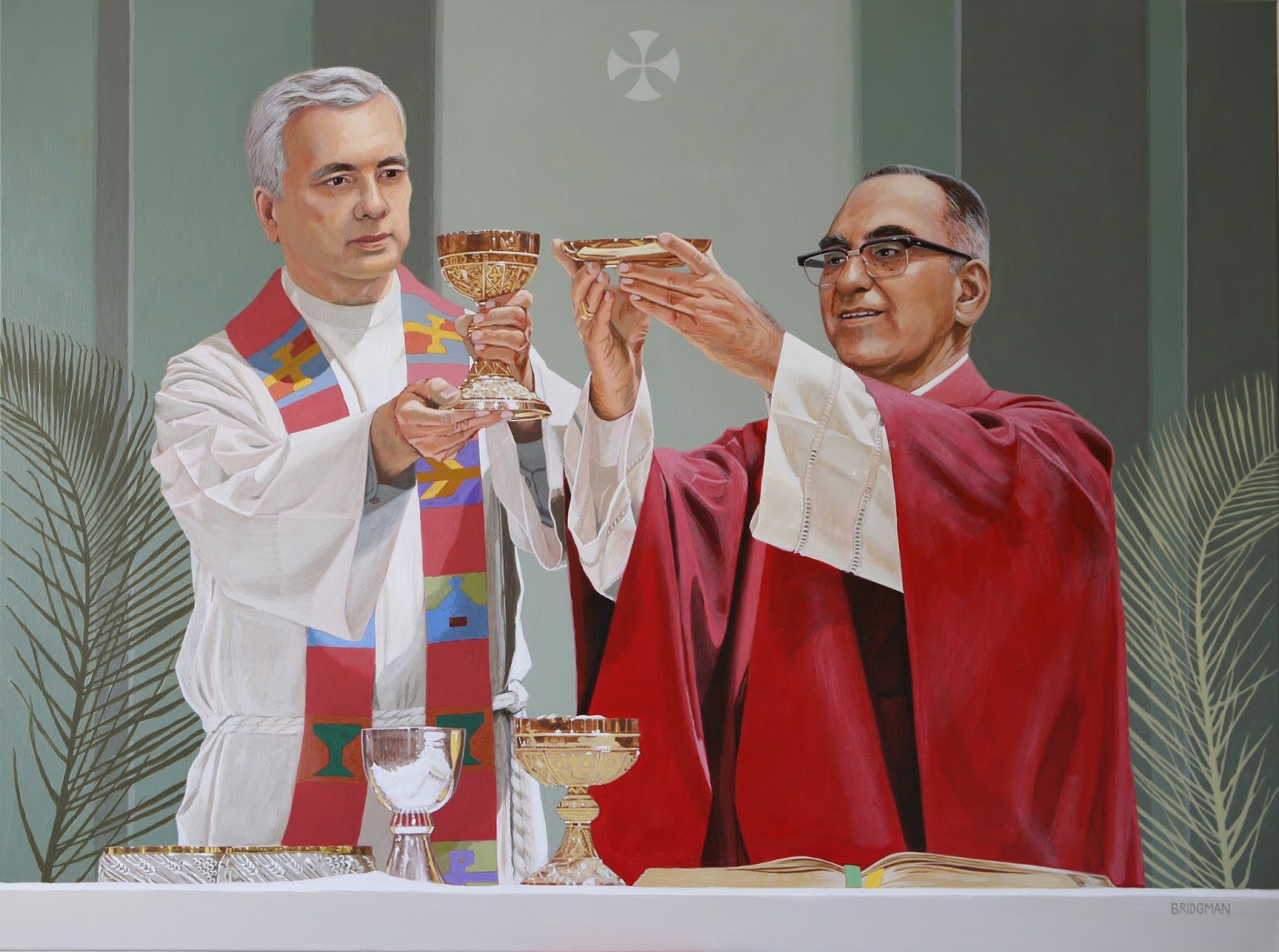
| “The Great Amen” by Peter Bridgman |
The announcement of the approval of the martyrdom of the
Salvadoran Fr. Rutilio Grande highlights the friendship of this new personality
headed to the altars with the most famous Salvadoran martyr Saint Oscar Romero.
The two men were friends, and the martyrdom of the now venerable P. Grande in
1977 is seen as the
trigger for the martyrdom of St. Romero three years later.
In this post, we will see that the truth is a multi-layered story, which turns
on the mystery of the enigmatic friendship between a conservative bishop and a
progressive, younger priest.
The first take on the relationship between Romero and Grande
comes through sources such as the
“Romero” movie (1989), which portrays the
murder of the priest as moving the archbishop such that it leads to a “conversion”
in his way of analyzing Salvadoran reality, and eventually leads to his own
martyrdom. “
It is impossible to understand Romero without understanding
Rutilio Grande,” says Archbishop Vincenzo Paglia, the Roman postulator of
Romero’s canonization cause. Although most people familiar with the subject
would consider it an exaggeration to say that the death of Grande was the only
factor in Romero’s “conversion,” it is generally acknowledged that the murder provided
a substantial boost to a process that was many years in the making. At a minimum, it
helped Romero recognize the injustice of repression when it befell a priest he
knew and about whom it would be hard to say that he instigated violence or
deserved such a brutal death.
“
We cannot imagine Father Grande,” Romero said six
months after his death, “
hating, asking for vengeance or inciting
violence. These words were the
slanderous words of his assassins. Those
who knew him know that it was impossible for him to have feelings of hatred in
his heart even though his assassins were able to and continue to imagine such a
reality.” (
November 1, 1977 Homily.)
A second way of analyzing the relationship between Romero
and Grande is from the interpersonal standpoint: two human beings and their
friendship. But, like
“The Odd Couple” in Neil Simon’s play, Romero and Grande come
across like characters who should not be friends. This is the central mystery
of their friendship: Romero got along well with Grande precisely at a time when
he alienated himself from the young progressive clergy in San Salvador, in the
early 1970s, and when he had a conflictive relationship with the Jesuits
(Grande was a Jesuit). Father Rodolfo Cardenal, SJ, historian of Father Grande’s
beatification cause, admits that “
there is not much information on the
development of the friendship.” Therefore, it is not known precisely how
they met, what they had in common, and what kept them together: “
But there
is evidence that [their friendship]
was strong and ran deep.”
In her book,
Rutilio Grande: A Table for All, Rhina Guidos presents Rutilio and Romero as
two sides of the coin in relation to the Church. They perfectly embody the two
currents in conflict in the Latin American Church after the Second Vatican Council:
Rutilio with his broad and reformist vision, and Romero with an approach
attached to hierarchy and tradition. However, honor, love for the Church and genuine
loyalty (because they were real friends) keeps them together, like
Pironio
and Quarracino in Argentina.
José Inocencio “Chencho” Alas, a former Salvadoran priest
who met them both, says: “
Father Rutilio had no ideological barriers, he was
kind and helpful to everyone. He was a pastor just like Saint Oscar. “
A third approach tries to explain the Romero-Rutilio
relationship from a
psychological point of view. Father Cardenal explains: “
They
met at the seminary, at a time when both were going through difficult times.”
It was 1967, and Romero had been both named a monsignor and secretary of the
episcopal conference, transferred from his home province of San Miguel after
twenty years working there, to work in the capital San Salvador where he had no
allies. Father Grande finds him a room in the seminary, which was run by the
Jesuits, in which Grande was positioning himself to become the rector. Romero
is made a bishop and he asks Grande to organize the ordination ceremony, which
he does with such attention to detail, that Romero, an infamous perfectionist,
is eternally impressed. “
At culminating moments in my life, he was very
close to me and I will never forget his gestures of friendship,” Romero
would remember at Grande’s funeral. (
Hom. 14-Mar.-1977;
see also
dramatization from “Romero” film.)
However, Grande provokes the establishment with a bold
homily and loses the favor to become the rector, while Romero also finds
conflict in his work as auxiliary bishop. Romero ends up bishop of a rural diocese,
and Grande pastor of a marginal parish. Grande’s generosity with Romero, and their
mutual adversity seems to have linked the two clerics, and perhaps also the
similarity between Grande and a friend from Romero’s youth,
Msgr.
Rafael Valladares, who also passed away before he turned 50 (Valladares died
at 48 and Grande at 49).
A fourth reading, more spiritual but related to the first,
is the one that sees Grande as a precursor prophet for Romero — there has been
talk of
Grande as John the Baptist, who announces the coming of one greater
than he. Pope Francis also speaks in spiritual terms when he refers to Romero
as “
Rutilio Grande’s first miracle.” Cardinal Angelo Amato, former prefect of
the Congregation for the Causes of Saints, presented the two martyrs as partners
in a shared ministry when he beatified Romero: after the assassination of
Grande in 1977, “
the peasants were now orphaned of their good father and
Romero wished to take his post.” (
Beatification
Homily, May 23, 2015.) Romero takes Grande’s place to sub in as ‘Father of
the Peasants.’ It is an idea echoed among the Salvadoran faithful, who claim they
heard Grande’s prophetic tone in Romero’s preaching as soon as he began to
denounce the assassination. In any case, a theological relationship is attributed,
not just one of cause and effect on the human plane, but also in the encounter
between the actions of men and the providence of God.
Finally, a fifth view of the relationship between Fr. Grande
and Archbishop Romero is based on the first perspective, but modifies it to
account for the remaining information, to reach an integral analysis of the
facts: Yes --- Rutilio Grande pushed Abp. Romero to conversion, but he did so
from
before his assassination. In other words,
it was not only
Rutilio’s death that inspired Romero, but also his life. In fact,
Rutilio also underwent a sort of “conversion” of his own, leaving the comfort
of the seminary to immerse himself in the life and cause of the poor. Pope
Francis himself highlights that option: “
He left the 'center' to move to the
outskirts. He was a great one.” Rutilio was also radicalized, which is
evidenced
in his style of preaching through the years. But he never departed from his
essentially ecclesial mission: he died en route to celebrate a St. Joseph novena
(just as Romero died celebrating mass). Romero took note of it, and he was impacted
by the example.
Romero and Rutilio: friends, an odd couple, embodiments of competing
Church models, associate prophets, or a template and imitator? It may be that
each of these paradigms takes us a little closer to the truth about these two
men that the Church now proposes as models of holiness.